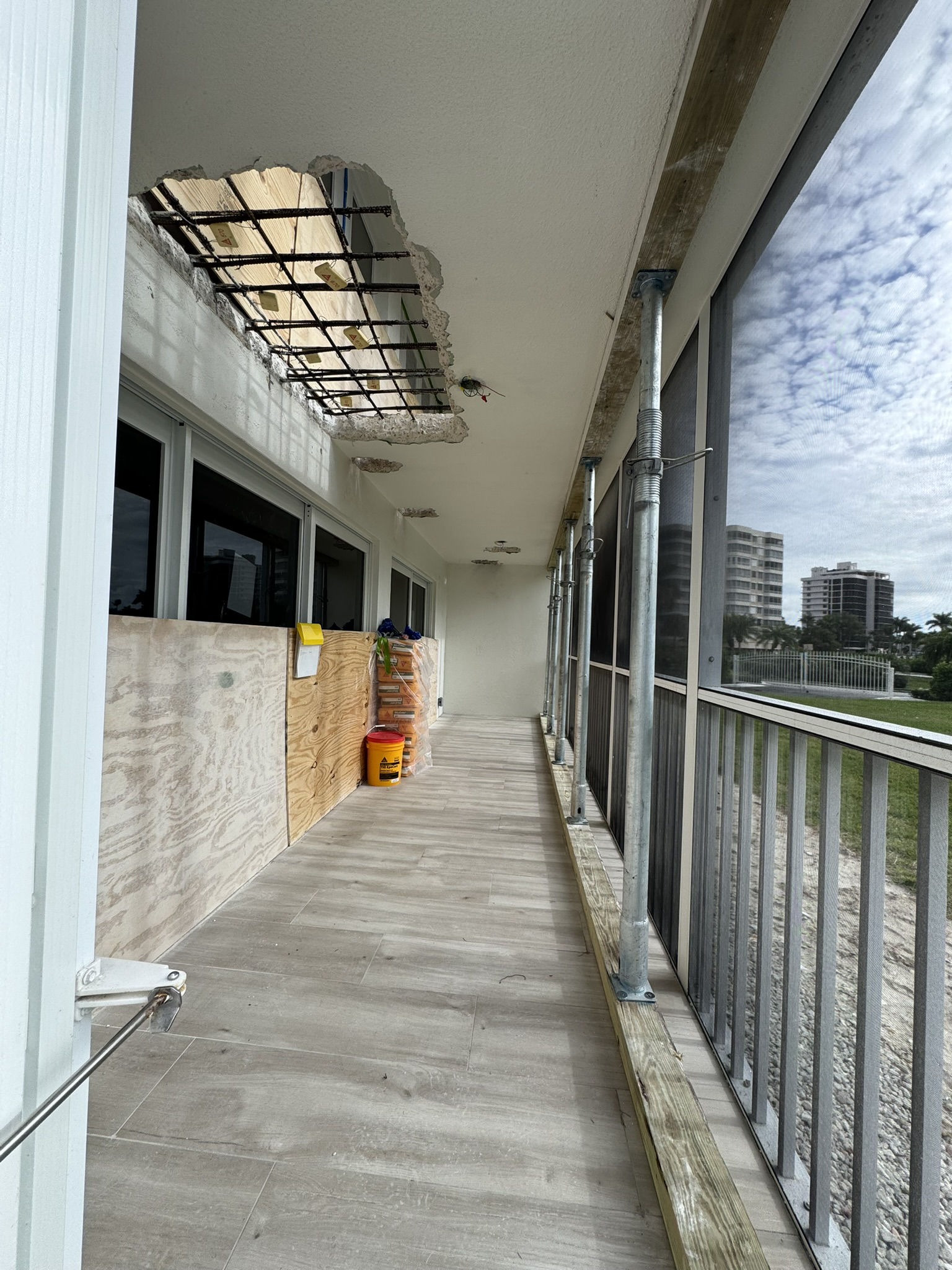
Rust stains bleeding down a balcony edge. A patch of concrete that sounds hollow when tapped. A chunk that finally lets go and takes the stucco with it. That is spalling — and in salt-air Florida it is the single most important maintenance item a condominium board owns.
What is actually happening inside the concrete
Concrete protects the steel reinforcement inside it with alkalinity and cover. Salt air and moisture slowly carry chlorides through that cover. When they reach the rebar, the steel corrodes — and rust occupies several times the volume of the steel it came from. That expansion pressure cracks the concrete from the inside until a piece breaks away (spalls). The exposed steel then corrodes faster, which is why spalling accelerates: every season you wait, the repair quantity grows.
This is why painting over a spall is not a repair. The coating hides the stain while the rebar keeps losing cross-section underneath. On balconies and walkways, that steel is what carries the load.
Why Florida boards can't defer this anymore
Since the post-Surfside reforms, Florida condominiums three stories and taller face milestone structural inspections and funded reserves (SIRS) — and visible spalling is exactly the kind of condition those inspections document. Boards that map and repair spalling on their own schedule control the scope and the budget. Boards that wait until an engineer's report forces the issue pay rush pricing, and often for shoring and emergency protocols on top.
How a proper repair actually works
- Sound and map. Every suspect surface is tapped ("sounded") and the hollow areas are marked and measured — this is where honest unit pricing comes from.
- Shore where needed. Structural members and balcony edges get temporary support before demolition.
- Remove to sound concrete. Saw-cut the perimeter, chip out deteriorated concrete past the rebar until clean material is reached.
- Treat or replace the steel. Corroded rebar is cleaned and primed with a corrosion-inhibiting coating — or, where section loss is too great, supplemented or replaced per the engineer's detail.
- Rebuild with engineered repair mortars. Polymer-modified, shrinkage-compensated repair mortars matched to the structural application — not bagged patch mix.
- Protect the envelope. Waterproof deck or wall coatings and new joint sealants slow the chloride ingress that caused the problem, which is what actually lengthens the next cycle.
What it looks like in practice
Our Vanderbilt Towers project in Naples is a good picture of the full sequence on an occupied tower: spall survey and mapping, shoring, demolition to sound concrete, new reinforcing steel set into cut repairs, formed pours, and protective coatings — phased so residents kept using the building throughout. The same discipline scales down to a single walkway landing, like our Bermuda Gardens restoration.
Early warning signs for your next walkthrough
- Rust-colored staining on soffits, balcony edges, or walls
- Hairline cracks that follow straight lines (tracing the rebar beneath)
- Hollow sound when tapping suspect areas
- Bubbling or lifting coatings at slab edges
- Exposed steel anywhere — that stage is already structural
Seeing any of these on your property? Request an assessment — we typically walk the building within 48 hours and return a mapped, unit-priced restoration proposal — or call (239) 772-1302.